


Indoor cycling apps have come a long way. Once, it was just about keeping the legs turning when the weather sucked. Now, there’s realism, community, gamification, serious workouts, and big monthly fees. If you can’t choose between Rouvy vs Zwift: which one is better? Here are my thoughts after riding both enough to notice the pros and cons.

Rouvy vs Zwift In a Nutshell
- Zwift is like an entire virtual cycling universe. Think fantasy worlds (Watopia), leaderboards, unlocking gear and jerseys, mass participation races, group rides, social interaction. If you want a lively online scene, Zwift delivers.
- Rouvy tries to deliver something different. Instead of riding through cartoon or purely virtual terrain, you ride through video recordings of real roads, mountain passes, coastal climbs, scenic countryside. Rouvy also mixes in some augmented reality elements (overlays, avatars, etc.) so you’re not just chasing a flat video. More “I’m on an actual road, sort of” kind of feeling.
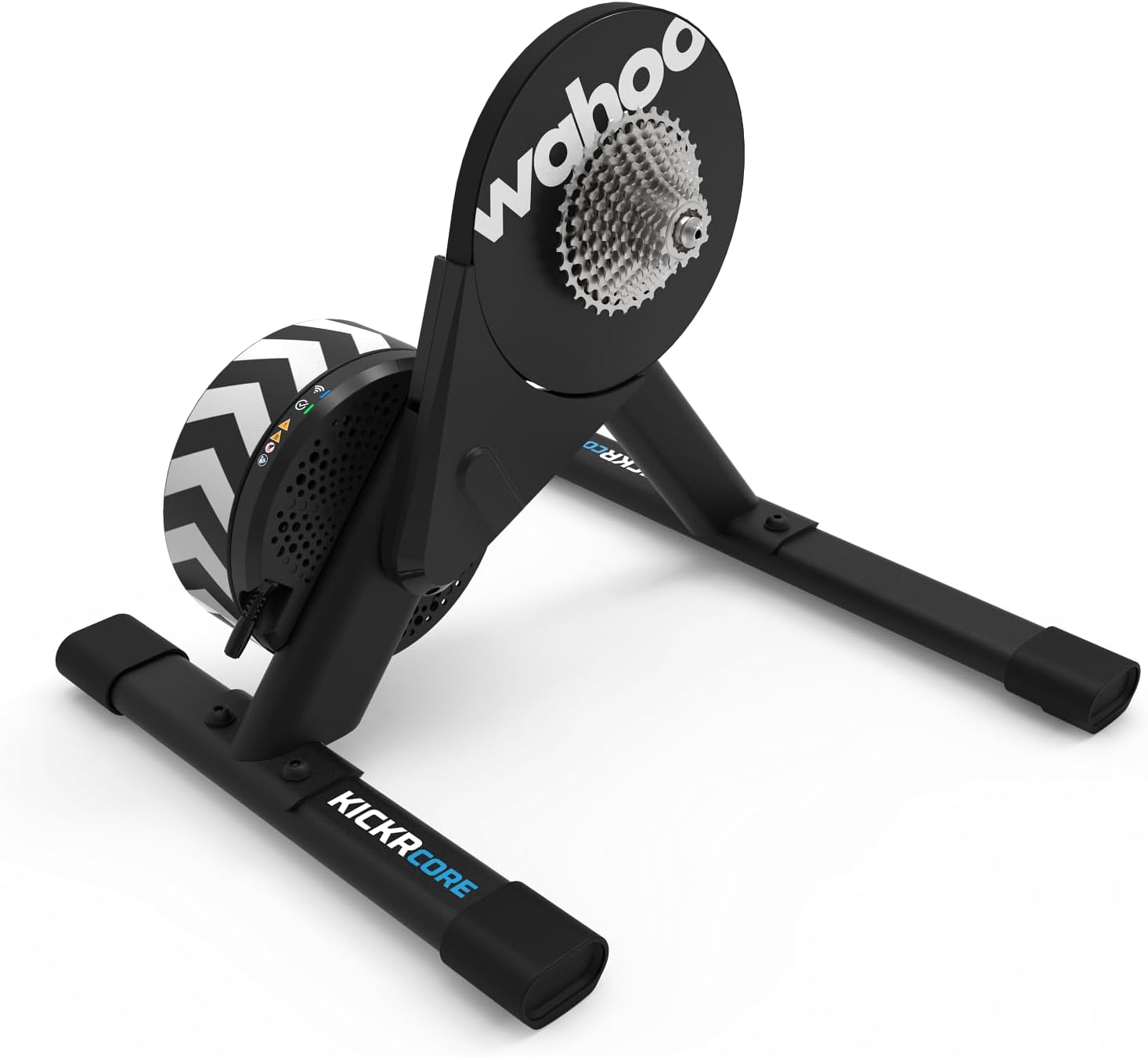
KICKR CORE is the smarter way to start riding indoors. The new KICKR CORE builds on the trusted performance of the original CORE, and introduces a faster and easier setup with better connectivity.
Realism: The Big Advantage for Rouvy
What I like about Rouvy (and what often draws people to it) is that immersive realism. Instead of riding in a fantasy world, you’re looking at places that exist, real curves, drops, scenery, weather, everything. The audio-visual experience (I like to call it the “live road views”) makes a difference: it helps me feel like I actually went outside rather than staring at graphics.
Some specific features:
- OmniMode: gives you more camera angles. You can look around, see what’s behind, static panorama, rear view, etc., which helps with immersion.
- Corner braking: when the route video shows a sharp turn, the speed drops, just like an outdoor ride.
- Route Creator: you can record your own roads/video, upload them, add AR features, so you can ride something local or personal indoors.
These make Rouvy feel more like “riding roads I know (or want to know)” rather than riding in a gaming universe. For people who miss being outside, that counts.
Community, Competition, and Zwift’s Strengths
Where Zwift shines is in the liveliness. Its strengths:
- Events & group rides: Lots going on constantly. Races, scheduled rides, social hangouts. If you like pushing yourself, matching up with others, or having the calendar full of things to join, Zwift is hard to beat.
- Gamification and motivation: Levels, unlocking gear, riding avatars you recognize, competing on KOMs (King/Queen of the Mountain) or segments, leaderboards. When you see someone is ahead, you chase. That can be addictive (in the good way).
- Polish, ecosystem, devices: Because it’s been around longer, Zwift has many integrations, apps, compatible trainers, and a big, active user base. That often means stuff works more smoothly; support is easier to find; there are more people to ride with at odd hours.
So if what drives you is competition + social + reward + constant fresh content, Zwift gives you more of that.

Price & Value
Here’s where things get interesting. Zwift has long been the more expensive option, but Rouvy has caught up, especially since 2025. Some key points:
- Zwift raised its membership fee globally. In the EU / UK / US etc., the monthly membership is about €19.99 / £17.99 / $19.99 (depending on region) with annual options.
- Rouvy used to be noticeably cheaper, but with its 2025 price increase, its single-member monthly plan is now about the same (EU €19.99 / US $19.99). If you pay annualy, it’s €15 per month.
- Where Rouvy still has an edge is in multi-user / shared accounts (duo, group). If you ride with a partner or share with someone in your household, those plans make Rouvy look better value.
- Rouvy also offers flexibility: you can pause your subscription part of the year (up to 180 days), which is useful for seasonal riders.
So, the cost argue is no longer “Zwift expensive, Rouvy much cheaper” like it used to be. The difference has narrowed, and some of Rouvy’s perks make the extra cost more palatable.
Weaknesses & What to Watch Out for
To be fair, neither app is perfect. Depending on what you care about, each has downsides.
Rouvy:
- The video stuff needs good internet/bandwidth (or you pre-download). Sometimes the streaming can lag, or there are visual artefacts (video distortion at edges, etc.). Users mention issues with video quality, frame issues, etc. (Tip: Download the route before you ride it).
- Less social. If you thrive on big group rides, drafting, chasing people, Zwift might give more. Rouvy has group features and events, but typically less active.
Zwift:
- As said: cost is high, and costs have been rising. For riders who only ride indoors occasionally, or who can’t commit every month, might feel like steep payment.
- Because everything is virtual, you lose out on that “this place is real” sensation. The climbs are believable in gradient, but visually you know you’re in a generated world. Some people miss the real roads.
- Sometimes big crowds in Zwift mean it’s more about the competition and spectacle, less about quiet enjoyment of “just riding.” If you’re in a mood to ride calmly, it can feel overwhelming.
MyWhoosh: An Outside Option
I also want to flag MyWhoosh. It’s newer in many markets, but people are talking. What I found:
- It offers free access (or a freemium model) in many regions. Good if you’re testing the waters or don’t want to commit to a high monthly fee.
- It has social rides, group rides, similar virtual world styles (more like Zwift’s aesthetic).
- Feature-wise, it isn’t yet as mature or rich as Zwift or Rouvy; the content library, stability, polish, and community size are still growing. But it is a solid alternative if you dislike the high cost of Zwift or want to mix things up.

What I Like
Here’s where I land after spending dozens of rides on both.
I tend to prefer Rouvy for the scenery, being able to ride roads that are real, seeing trees, landscapes, climbs I recognise or want to try. The “live road feels” (if that makes sense) make long hours on the trainer less of a grind. On the other hand, when I want to push myself, do races, ride with others at specific times, Zwift gives more adrenaline, more people, more stimulus to dig deeper.
So:
- If your priority is realism, enjoying indoor rides as rides (not just training), grim winter sessions made better by beautiful roads, Rouvy is probably more satisfying.
- If your priority is competition, pushing limits, having lots of options of races, community events, Zwift is more suited.
- If you ride a lot and want the most bang for what you pay, shared accounts, flexible pricing, etc., factor those in. And think about, do I want community or realism more? That trade-off often decides it.
Conclusion
So, which one is “better”? Depends on what you want.
Rouvy is best for realistic rides through real locations, Zwift excels for racing and community events, and MyWhoosh offers a free option with solid variety.